

The Future of Education & Training: Immersive Learning with AR/VR
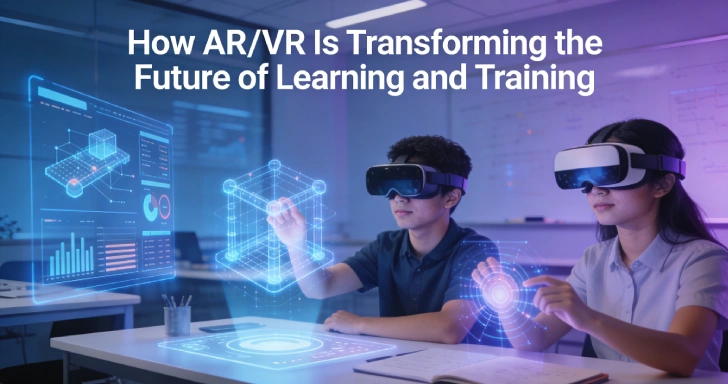
How AR/VR Is Transforming the Future of Learning and Training
The Education Transformation
The world of education is undergoing one of the biggest transformations in decades. Digital learning is no longer limited to online videos, e-books, or virtual classrooms. Today, Augmented Reality (AR) and Virtual Reality (VR) are reshaping the way students learn, employees train, and institutions deliver knowledge.
This shift is not a temporary trend—it's rapidly becoming one of the strongest pillars of the modern learning ecosystem.
AR overlays digital information on real environments, while VR immerses learners into a fully virtual world. When combined, they create an immersive learning experience that makes education more engaging, interactive, and effective. And as industries demand faster, smarter, and more practical learning methods, AR/VR are stepping in to bridge that gap.
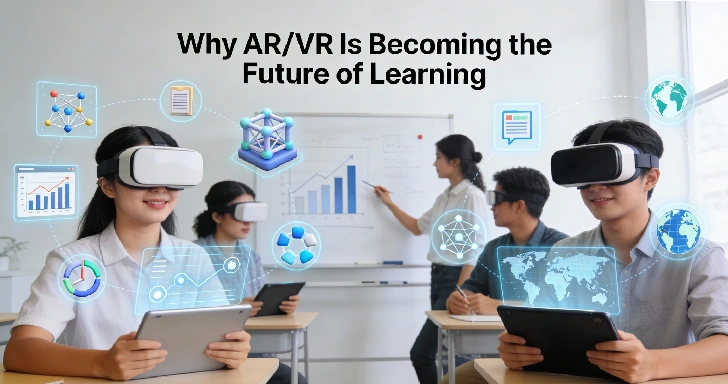
Why AR/VR Is Becoming the Future of Learning
Education is evolving for three main reasons: the need for faster skill development, the growing demand for lifelong learning, and the limitations of traditional teaching models. Immersive learning addresses all these challenges with unmatched efficiency.
Higher Knowledge Retention
Interactive experiences lead to better memory formation and recall compared to passive learning methods.
Hands-on Learning Without Risks
Practice complex procedures in safe, controlled environments without real-world consequences.
Personalized Training
Adaptive learning environments that adjust to individual needs and learning pace.
Cost-Effective Long-Term
Reduced need for physical materials, travel, and specialized facilities over time.
Immersive Learning in Action
Educational institutions and businesses are already utilizing AR/VR to develop realistic learning experiences.
Medical & Healthcare Training
Practice surgery in risk-free environments and learn anatomy through AR-powered 3D visualizations.
Engineering & Technical Education
Explore complex machinery step-by-step and visualize components directly on equipment.
Corporate Employee Training
Immersive training for safety, leadership, customer interactions, and equipment handling.
School Classrooms
Students can walk through historic locations, explore space, view 3D molecules, or conduct chemistry experiments safely and precisely.
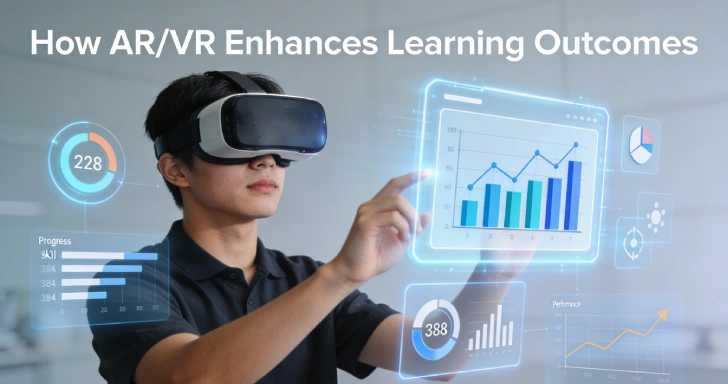
How AR/VR Enhances Learning Outcomes
Immersive learning systems improve results because of how the human brain responds to interactive environments. When learners experience a concept instead of reading or listening, they retain more information and feel more confident.
- Better memory recall through experiential learning
- Faster skill adoption with hands-on practice
- Reduced training time with focused experiences
- Higher engagement through interactive content
- Improved decision-making in simulated scenarios
- Increased motivation through gamification elements
Technologies Driving the Future of AR/VR Learning
The growth of immersive learning is supported by major technology innovations that work behind the scenes to enhance the learner's experience.
- AI-powered personalization that adapts learning difficulty
- 5G networks enabling real-time VR streaming
- Cloud-based XR platforms for device-friendly experiences
- Spatial computing creating natural 3D interactions
- Advanced sensors and haptics for realistic touch feedback
- Wearable AR glasses and standalone VR headsets
Traditional vs AR/VR Training
| Traditional Training Challenges | AR/VR Solutions |
|---|---|
| Limited practical exposure | Realistic simulations |
| Lower learner engagement | Interactive, hands-on practice |
| Higher cost for physical setups | Safe learning without dangers |
| Difficulty simulating real-world risks | Consistent training quality |
Industries That Will Experience the Biggest AR/VR Learning Impact
Healthcare
Surgical training & patient care
Manufacturing
Assembly line & equipment operation
Aviation
Flight simulation & maintenance
Retail & E-commerce
Customer service & product training
Defense
Combat simulation & strategy
IT & Software
System administration & coding
Construction
Safety training & equipment operation
Automotive
Design & repair training
Challenges AR/VR Must Overcome
Even though AR/VR is promising, certain limitations still need attention for widespread adoption.
- Hardware cost and accessibility
- Motion sickness for new users
- Need for high-quality learning content
- Technical skill gaps in educators
- Network and device compatibility issues
- Limited long-duration use due to comfort and battery
Future Advancements in AR/VR Training
The future of immersive learning looks extremely promising. Over the next few years, AR/VR will shift from optional innovation to essential learning infrastructure.
- Fully immersive virtual campuses
- Teacher-guided AR classrooms
- Global collaborative VR learning hubs
- Skill-based training simulations powered by AI
- Personalized learning pathways for every student
- Real-time AR/VR translation for cultural immersion
Conclusion: A New Era of Learning Has Begun
AR/VR is no longer a futuristic experiment. It is now one of the most powerful tools transforming education and training worldwide.
By combining immersion, interactivity, and intelligence, AR/VR creates learning experiences that go beyond books, lectures, and screens.
The future of education will be shaped by immersive technologies—and those adopting them early will stay ahead in innovation, skill development, and global competitiveness.