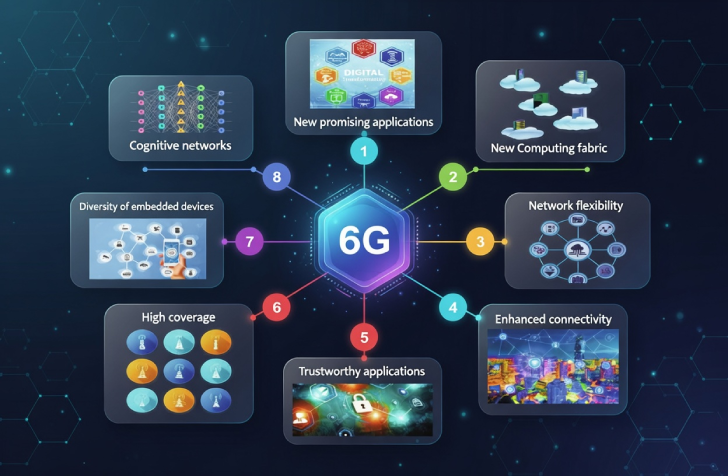
AI-Native Networks: How Artificial Intelligence Powers 6G
The evolution of mobile networks has always followed a simple rule: each generation delivers faster speeds, lower latency, and broader connectivity. But 6G is different.
Unlike previous generations, 6G is not just an upgrade in speed—it represents a fundamental shift in how networks think, adapt, and operate. At the heart of this transformation lies AI-native networks, where artificial intelligence is not an add-on but the core foundation.
As the world moves toward hyper-connectivity, real-time intelligence, and immersive digital experiences, AI-powered 6G networks will redefine communication, industries, and everyday life.

What Are AI-Native Networks?
AI-native networks are communication systems designed from the ground up with artificial intelligence embedded into every layer—from radio access and core networks to edge computing and applications.
In previous generations like 4G and 5G, AI was used mainly for optimization tasks such as traffic prediction or fault detection. In contrast, 6G networks are AI-first by design, meaning:
-
AI continuously learns network behavior
-
Decisions are made autonomously in real time
-
Networks self-configure, self-heal, and self-optimize
This approach transforms networks from static infrastructure into living, intelligent systems.
Why 6G Needs Artificial Intelligence
The demands placed on future networks go far beyond what manual or rule-based systems can handle. 6G will support:
Terahertz-level data speeds
Ultra-low latency (microseconds)
Massive IoT and machine-to-machine communication
Holographic calls, extended reality (XR), and digital twins
Autonomous vehicles and robotic systems
Managing this complexity without AI is impossible. Artificial intelligence enables 6G networks to handle billions of devices, unpredictable traffic patterns, and mission-critical applications—simultaneously and reliably.
Key Ways AI Powers 6G Networks
1
Intelligent Network Architecture
In AI-native 6G, the network architecture itself is intelligent. AI models are embedded across:
-
Radio Access Networks (RAN)
-
Core network functions
-
Edge and cloud layers
This allows the network to dynamically adapt to changing conditions, user behavior, and application needs without human intervention.
Result: Faster response times, higher reliability, and optimized resource usage.
2
Autonomous Network Management
One of the biggest breakthroughs of AI-powered 6G is full network autonomy.
AI algorithms continuously monitor performance, detect anomalies, predict failures, and take corrective action instantly. This includes:
-
Self-healing networks that fix issues before users notice
-
Predictive maintenance for infrastructure
-
Automated traffic routing for optimal performance
For telecom operators and enterprises, this means lower operational costs and higher service quality.
3
AI-Driven Spectrum Optimization
Spectrum is a limited and valuable resource. In 6G, AI enables dynamic spectrum sharing, where frequencies are allocated in real time based on demand, location, and usage patterns.
AI models analyze massive datasets to:
Maximize spectral efficiency
Support dense urban and industrial environments
This makes 6G networks more sustainable and scalable.
4
Edge Intelligence and Real-Time Decision Making
6G networks rely heavily on edge AI, where intelligence is pushed closer to devices and users.
By processing data at the edge instead of centralized clouds, AI-native networks enable:
-
Ultra-low latency communication
-
Real-time analytics and decision-making
-
Enhanced privacy and data security
This is critical for applications like autonomous driving, remote surgery, smart factories, and immersive XR experiences.
5
AI-Enabled Sensing and Communication
Unlike previous generations, 6G networks will not only communicate data—they will also sense the physical environment.
AI helps 6G systems interpret signals to detect:
-
Object movement and positioning
-
Environmental conditions
-
Human gestures and presence
This fusion of sensing and communication unlocks advanced use cases such as smart cities, industrial automation, and intelligent transportation systems.
AI-Native 6G Use Cases Across Industries
Smart Cities
AI-powered 6G enables real-time traffic management, energy optimization, public safety monitoring, and connected infrastructure that adapts dynamically to city conditions.
Healthcare
From AI-assisted diagnostics to remote robotic surgery, 6G ensures ultra-reliable, low-latency connectivity where human lives depend on precision and speed.
Manufacturing and Industry 5.0
AI-native networks support intelligent robots, digital twins, predictive maintenance, and autonomous production systems in smart factories.
Extended Reality and Metaverse
6G combined with AI enables seamless AR, VR, and holographic communication experiences without lag or disruption.
Security and Trust in AI-Powered 6G Networks
Security is a major concern in hyper-connected environments. AI-native 6G networks address this by embedding intelligent security mechanisms into the network itself.
AI helps by:
Detecting threats in real time
Predicting cyberattacks before they occur
Enforcing zero-trust architectures
Supporting quantum-safe encryption strategies
This proactive approach makes 6G networks more resilient than any previous generation.
Common Questions Answered
| Question |
Answer |
| What makes 6G different from 5G? |
6G is AI-native, meaning intelligence is built into the network core rather than added later. |
| How does AI improve network performance? |
AI enables real-time optimization, autonomous management, predictive maintenance, and smarter resource allocation. |
| When will 6G become available? |
Global research is ongoing, with early deployments expected around 2030–2035. |
The Future of Connectivity Is Intelligent
AI-native networks represent the most significant shift in communication technology to date. By embedding artificial intelligence at every layer, 6G becomes more than a network—it becomes an intelligent platform for innovation.
As industries, governments, and societies prepare for the 6G era, one thing is clear:
The future of connectivity is not just faster—it's smarter, adaptive, and deeply intelligent.
Organizations that understand and invest in AI-powered networking today will lead the digital world of tomorrow.