

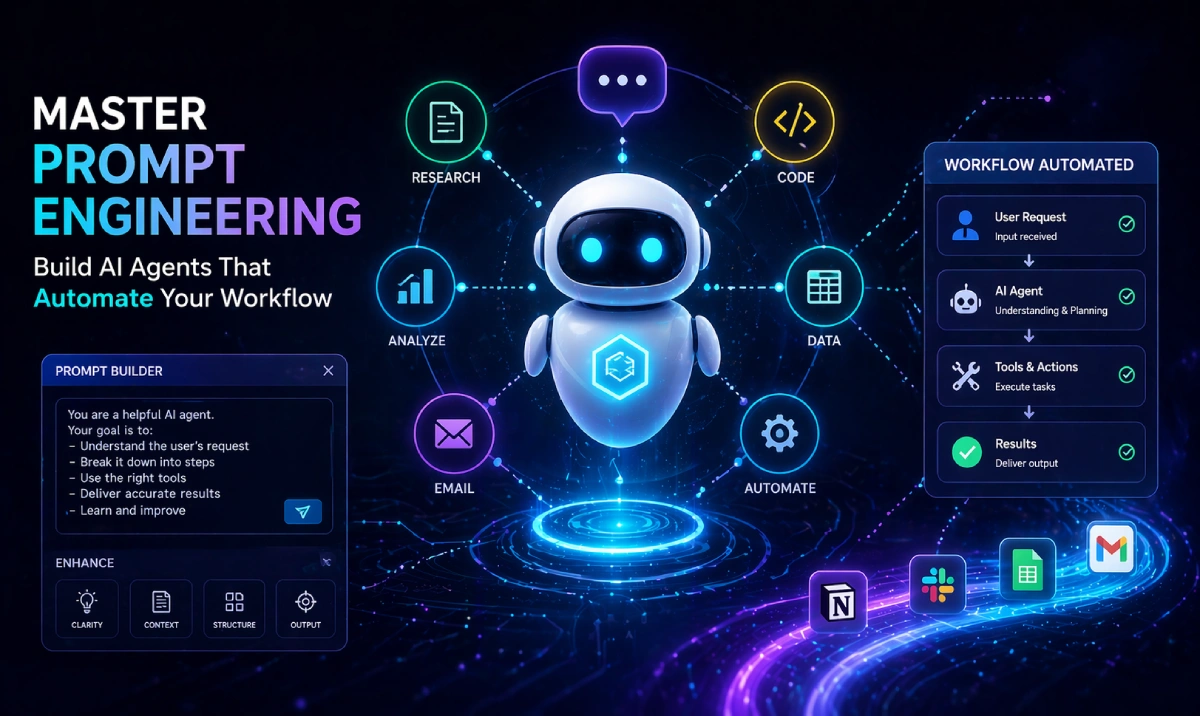
Master Prompt Engineering: Build AI Agents That Automate Your Workflow
The gap between a helpful chatbot and a fully autonomous AI agent comes down to one thing: prompt engineering. As large language models (LLMs) like GPT-4, Claude, and Gemini become embedded in production stacks, the ability to craft precise, structured, and goal-oriented prompts has evolved from a convenience into a core engineering discipline.
This article explores how advanced prompt engineering techniques enable you to build AI agents capable of automating complex, multi-step workflows — transforming how teams handle repetitive cognitive work at scale.
The foundational principles of effective prompt design for LLMs
How to architect multi-step AI agents using prompt chaining
Advanced techniques: CoT, ReAct, few-shot, and tool-use patterns
A practical framework for building workflow automation agents
Common pitfalls and how to avoid them in production deployments
What Is Prompt Engineering
Prompt engineering is the practice of deliberately designing inputs to language models to elicit accurate, contextually relevant, and task-appropriate outputs. Far from simply 'asking questions,' modern prompt engineering involves structural design, contextual scaffolding, constraint definition, and iterative refinement.
The stakes have risen significantly. According to OpenAI's published guidelines and research from DeepMind, the quality of a prompt can influence model accuracy by 20–40% on complex reasoning tasks. When you are building AI agents that execute real actions — calling APIs, writing code, parsing documents, or managing data pipelines — this margin is the difference between a reliable automation and a costly failure.
Poorly structured prompts produce ambiguous outputs that require manual review.
Well-engineered prompts enable zero-shot task completion, reducing human-in-the-loop costs.
In multi-agent systems, prompt clarity compounds: one weak link degrades the entire pipeline.
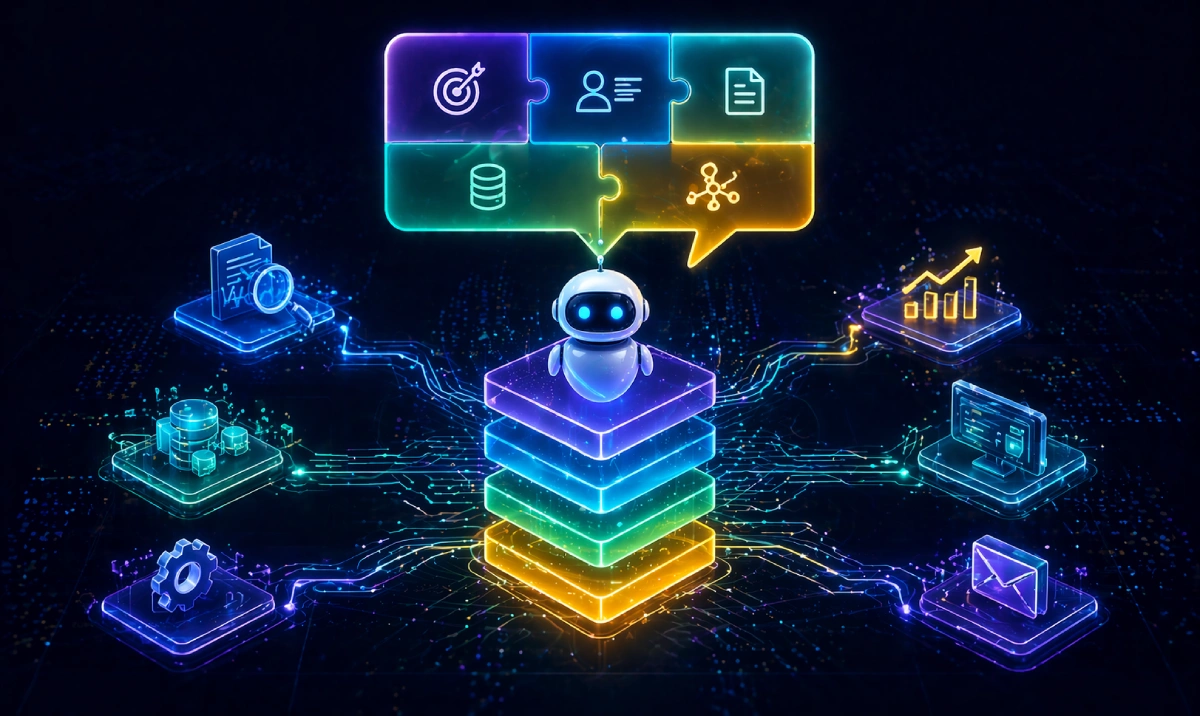
Structured prompt architecture forms the backbone of reliable AI agent systems
The Anatomy of a High-Performance Prompt
A production-grade prompt is not a sentence — it is a structured specification. The most effective prompts for agentic systems typically include six core components:
| Component | Purpose |
|---|---|
| Role / Persona | Anchors the model's behaviour and domain expertise |
| Context / Background | Provides situational awareness and relevant constraints |
| Explicit Task | Defines the specific action or output expected |
| Output Format | Specifies structure (JSON, markdown, step list, etc.) |
| Constraints | Boundaries on tone, length, scope, or permissible actions |
| Examples (Few-shot) | Calibrates expected quality and format via demonstrations |
Positive and Negative Examples in Practice
Providing both a correct example and an incorrect one (with a short explanation of why it fails) dramatically improves model compliance on constrained tasks. This technique is particularly powerful when building AI agents that must return structured data formats for downstream processing.
Include a well-structured demonstration showing the exact output format, field values, and reasoning trace you expect — the model mirrors this pattern precisely.
Show an incorrect output with a brief annotation like "Missing required fields and incorrect date format" — the model learns what NOT to produce.
The Role of System Prompts in Agentic Architectures
In agent systems, the system prompt acts as the agent's 'operating manual.' It should define the agent's identity, available tools, decision logic, and escalation paths. Treating the system prompt as configuration code — version-controlled and tested — is a best practice adopted by leading AI engineering teams.
Advanced Techniques for Building Autonomous AI Agents
Building AI agents that can autonomously navigate multi-step workflows requires moving beyond single-turn prompting. The following techniques are the foundation of modern agentic prompt design:
Chain-of-thought prompting instructs the model to reason step by step before producing a final answer. Introduced in the landmark paper by Wei et al. (2022), CoT dramatically improves performance on tasks requiring logical inference, arithmetic, and multi-step planning.
For workflow automation, CoT is invaluable because it exposes the model's reasoning process, making it easier to debug, validate, and build trust in the agent's decisions.
Instruction: "Analyze the following customer support ticket and determine the appropriate escalation path. Think step by step before providing your final recommendation."
Why it works: Forces the model to surface intermediate reasoning, reducing hallucination on complex conditional logic and making output auditable.
The ReAct framework, developed at Princeton and Google Research, interleaves reasoning traces with action calls. An AI agent using ReAct alternates between Thought (planning the next step), Action (calling a tool or API), and Observation (processing the result).
This pattern is the architectural backbone of most modern autonomous agents built on frameworks like LangChain, AutoGPT, and CrewAI. It enables agents to interact with external systems — databases, web browsers, code interpreters — while maintaining coherent task context.
Prompt chaining decomposes a complex task into a sequence of simpler sub-prompts, where the output of each step becomes the input for the next. This mirrors software pipeline design and enables:
- Greater control over each transformation stage
- Easier debugging and unit testing of individual steps
- Modular reusability of prompt components across different workflows
- Reduced token overhead per individual call
Search Agent: Find the top 5 recent papers on [topic] using web search tool.
Summarizer Agent: Summarize each paper in 100 words focusing on methodology and findings.
Synthesizer Agent: Identify key themes and contradictions across the summaries.
Writer Agent: Format the synthesis as a structured executive briefing in Markdown.
QA Agent: Review the output for factual consistency and flag any unsupported claims.
Modern LLMs support structured tool use (function calling), allowing agents to invoke predefined functions with validated parameters. This is a paradigm shift: the model is no longer generating free text, but rather making structured API calls that can be validated, logged, and executed safely.
When designing prompts for tool-use agents, clarity about when to use a tool versus when to reason internally is critical. Over-reliance on tools increases latency and cost; under-reliance causes the agent to hallucinate information it should be retrieving.
A Practical Framework: Building Your First Workflow Automation Agent
The following five-phase framework provides a reproducible process for architecting AI agents using prompt engineering principles:
Define Scope
Document the workflow's inputs, outputs, decision points, and failure modes before writing a single prompt.
Design Personas
Assign a role and expertise level to each agent in your pipeline — specificity improves output quality.
Write Modular Prompts
Author each prompt as a standalone specification. Test it in isolation before integration.
Implement CoT / ReAct
Add reasoning scaffolding to any prompt involving conditional logic, multi-source synthesis, or tool orchestration.
Evaluate & Iterate
Build a prompt evaluation harness with representative test cases. Track accuracy, latency, and token cost per iteration.
A key principle throughout this process: treat prompts as code. Store them in version control, document their intended behaviour, write tests, and conduct prompt reviews as you would code reviews. Teams that adopt this discipline see significantly lower failure rates in production agentic systems.
Common Pitfalls in Production Prompt Engineering
Even experienced teams make predictable mistakes when scaling prompt-driven automation. Awareness of these failure patterns is as valuable as mastering the techniques themselves:
Prompt Brittleness
Prompts that work perfectly in testing break on edge-case inputs. Mitigate by stress-testing with adversarial examples.
Context Mismanagement
Stuffing excessive context into a single prompt degrades attention quality. Summarize intermediate outputs aggressively.
Under-specified Constraints
Vague output requirements lead to inconsistent formatting. Always specify exact output schemas for structured tasks.
Ignoring Model Versioning
Prompt behavior can shift between model versions. Pin versions in production and establish regression tests.
No Fallback Logic
Agents that cannot handle unexpected tool failures will stall. Design explicit fallback instructions into every prompt.
The Future of Prompt Engineering: From Craft to Infrastructure
As AI agents become central to enterprise workflows, prompt engineering is maturing from an individual skill into an organisational capability. Emerging trends include:
Prompt Management Platforms
Tools like PromptLayer, LangSmith, and Weights & Biases are providing observability, versioning, and A/B testing infrastructure specifically for prompts.
Automatic Prompt Optimization (APO)
Research into DSPy (from Stanford) and similar frameworks is showing that prompts can be algorithmically optimized using gradient-like feedback, reducing manual iteration cycles.
Multi-Agent Orchestration
Frameworks such as CrewAI, AutoGen, and LangGraph are standardizing how prompt-engineered agents collaborate, delegate, and share memory — enabling enterprise-scale workflow automation.
Constitutional AI and Alignment-Aware Prompting
As AI autonomy increases, embedding safety constraints, ethical guidelines, and escalation protocols directly into agent prompts is becoming a governance requirement.
Key Takeaways
Prompt engineering is a structured engineering discipline — treat prompts as code.
CoT, ReAct, and prompt chaining are the core techniques for agentic automation.
Modular prompt design enables scalable, testable, and maintainable agent pipelines.
Production agents require evaluation harnesses, versioning, and explicit fallback logic.
The field is moving fast — invest in prompt infrastructure alongside prompt craft.
Prompt engineering for AI agents is not a trend — it is a foundational capability for any team building on top of large language models. The organizations that invest in prompt discipline today are the ones that will operate reliably intelligent, autonomous systems at scale tomorrow.
Ready to Build Intelligent AI Agents?
Transform your workflows with prompt-engineered AI automation. Let our experts help you architect, build, and deploy production-grade AI agent systems.
Visit us to learn moreFrequently Asked Questions
Prompt engineering for AI agents is the practice of crafting structured, goal-oriented instructions that direct large language models (LLMs) to perform autonomous, multi-step tasks. Unlike basic prompting for conversational AI, agent-focused prompt engineering involves defining roles, constraints, reasoning frameworks, and tool-use protocols — enabling the model to independently plan, act, and adapt across a workflow without continuous human intervention.
Chain-of-thought (CoT) prompting instructs the model to reason step by step internally before generating an answer. It is primarily a reasoning enhancement technique — the model thinks, then responds.
ReAct (Reasoning + Acting) extends CoT by interleaving reasoning with external actions. The agent cycles through Thought, Action, and Observation loops, enabling it to call tools and query APIs as part of its reasoning process. ReAct is the preferred pattern for agents that must interact with external systems during task execution.
The best model depends on task complexity, latency requirements, and budget. Leading options in 2025:
- GPT-4o (OpenAI) — Best-in-class for tool use, function calling, and complex reasoning.
- Claude 3.5 Sonnet (Anthropic) — Excels at long-context workflows, structured outputs, and instruction-following.
- Gemini 1.5 Pro (Google) — Strong multimodal capability and large context window for document-heavy workflows.
- Mistral / LLaMA 3 — Cost-effective open-source options for on-premise or privacy-sensitive deployments.
Hallucination mitigation in agentic systems requires a layered approach:
- Ground the agent in retrieved context using RAG (Retrieval-Augmented Generation) rather than relying on parametric memory.
- Use chain-of-thought prompting to expose intermediate reasoning, making errors visible and catchable before they propagate.
- Add a dedicated QA/validation agent at the end of your pipeline to fact-check outputs and flag unsupported claims.
- Set temperature to 0 or near-0 for deterministic, factual tasks — reserve higher temperatures for creative generation only.
The AI agent framework landscape has matured rapidly. Top choices in 2025:
- LangChain / LangGraph — Most widely adopted; excellent for prompt chaining, tool use, and stateful agent graphs.
- CrewAI — Best for multi-agent role-based collaboration where agents have distinct personas and responsibilities.
- AutoGen (Microsoft) — Designed for conversational multi-agent systems and code execution workflows.
- DSPy (Stanford) — Ideal when you want to programmatically optimize prompts rather than hand-craft them.
The nuanced answer: the form of prompt engineering will evolve, but the discipline will not disappear. As automatic prompt optimization (APO) tools like DSPy mature, manual crafting of individual prompts may become less common.
However, the higher-order skills — defining agent architecture, specifying constraints, designing evaluation harnesses, and aligning agent behavior with business goals — will remain deeply human responsibilities. Think of it like software engineering: compilers improved dramatically, but developers moved up the abstraction layer. Prompt engineers will do the same.