

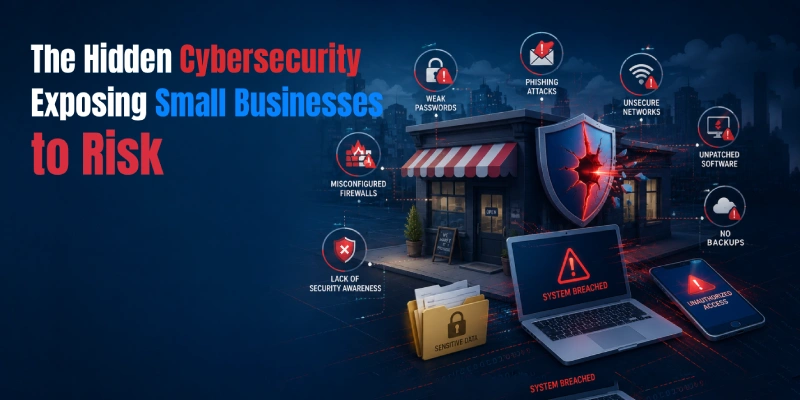
The Hidden Cybersecurity Gaps Exposing Small Businesses to Risk
Most small business owners still operate on a comfortable assumption: "We're too small for anyone to bother hacking." It's an understandable belief — and it's precisely why attackers keep proving it wrong.
Small businesses aren't collateral damage in the cybersecurity landscape; they are the primary target, chosen specifically because their defenses are thinner, their budgets are tighter, and their blind spots are wider.
The uncomfortable truth is that most breaches don't start with a sophisticated, headline-grabbing exploit. They start with an unpatched laptop, a shared password, a vendor with sloppy access controls, or an employee who clicks a convincing email. These are the hidden gaps — the everyday, unglamorous weaknesses that never make it onto a risk register until they've already been exploited.
This piece breaks down exactly where those gaps hide, why they persist even in businesses that "have security tools in place," and the practical framework that closes them — without requiring an enterprise budget or a dedicated security team.
Why Small Businesses Have Become Prime Targets
The numbers make the shift in attacker strategy hard to ignore.
According to Verizon's Data Breach Investigations Report, small and mid-sized organizations are targeted disproportionately compared to their size, largely because they combine valuable data — customer records, payment details, supplier credentials — with noticeably weaker defenses. Attackers aren't choosing small businesses despite the effort required; they're choosing them because the effort required is so low.
There's a second, less obvious reason: supply chains. Small businesses are frequently the entry point into a larger partner's network. A single compromised vendor account can give attackers a foothold into contracts, invoices, and systems well beyond the original target — which is exactly why third-party risk shows up later in this article as one of the most overlooked gaps of all.
The Hidden Gaps That Put Small Businesses at Risk
Most small businesses already own some security tooling — antivirus, a firewall, maybe a password manager. The problem isn't a total absence of protection; it's the gaps that sit between the tools. Here are the six that show up most consistently.
Shadow IT and Unmanaged Devices
Employees adopt apps, cloud storage, and personal devices for convenience, often without IT's knowledge. Every unsanctioned tool is an unmonitored door into company data.
- Personal phones and laptops accessing company email with no device management policy.
- Free or trial software installed by staff to "get the job done faster."
- Cloud storage accounts (personal Google Drive, Dropbox) holding business files outside IT's visibility.
Weak Identity and Access Management
Credentials remain the single most common entry point for attackers, and small businesses frequently under-invest in the basics of identity protection.
- No multi-factor authentication (MFA) on email, banking, or admin accounts.
- Shared logins used across multiple employees for convenience.
- Former employees retaining active access long after departure.
Industry research consistently finds that a large majority of hacking-related breaches involve compromised or stolen credentials. MFA alone — one of the cheapest controls available — blocks the overwhelming majority of these attempts.
Unpatched Software and Legacy Systems
Patching feels like a low priority until it's the reason an attacker got in. Legacy systems that vendors no longer support are especially dangerous because known vulnerabilities are never fixed.
- Operating systems and business applications running months, or years, behind on updates.
- End-of-life software still processing customer or financial data.
- No defined patch cadence or ownership — updates happen "whenever someone remembers."
Third-Party and Vendor Risk
Outsourcing payroll, IT support, marketing, or accounting is standard practice — but every vendor connection is also an extension of your attack surface. A breach at a vendor becomes a breach for every client it touches.
- Vendors granted broad system access with no review of their own security posture.
- No contractual requirement for vendors to disclose breaches promptly.
- API keys and integrations left active long after a vendor relationship ends.
Limited Employee Security Awareness
Technology can only do so much when a well-crafted phishing email lands in an inbox. Awareness training is often treated as a one-time onboarding formality rather than an ongoing discipline.
- Phishing simulations run rarely, if ever, after initial hiring.
- No clear process for employees to report suspicious emails or requests.
- Finance teams unaware of common invoice-fraud and business email compromise tactics.
No Documented Incident Response Plan
When an incident happens, the businesses that recover fastest are the ones that already knew exactly what to do. Most small businesses discover they have no plan at the worst possible moment.
- No defined roles for who leads communication, containment, and recovery during an incident.
- No relationship established with a cybersecurity or legal partner before a crisis hits.
- Backups exist but have never actually been tested for a full restore.
Having security tools is not the same as being protected. A firewall and antivirus solve for known threats; the gaps above are what attackers exploit precisely because they sit outside the tools businesses already trust.
From Reaction to Resilience: A Practical Framework
Closing these gaps doesn't require an enterprise security budget — it requires shifting from a reactive posture to a proactive one, gap by gap.
A Five-Step Roadmap to Close the Gaps
Run an Asset and Access Audit
Map every device, account, and cloud service touching business data, then remove what no one can justify.
Enforce MFA and Least-Privilege Access
Require it on email, financial systems, and admin accounts, and give employees only the access their role needs.
Establish a Patch Management Cadence
Assign clear ownership and a fixed SLA for updates, and retire end-of-life systems on a set timeline.
Formalize Vendor Risk Assessments
Review security practices before granting access, and revoke it the day a relationship ends.
Build and Test an Incident Response Plan
Document roles, run a tabletop exercise annually, and verify backups with an actual restore test.
None of these steps demand a large team. What they demand is consistency — turning security from a once-a-year checkbox into a standing operational habit. For businesses that lack in-house expertise, partnering with a specialist team to run this framework is often the fastest and most cost-effective path to closing the gaps for good.
Frequently Asked Questions
Compromised credentials and phishing remain the leading cause of small business breaches, closely followed by unpatched software and poorly managed vendor access. Most incidents trace back to a basic control gap rather than a sophisticated attack.
Yes. Most ransomware incidents exploit known, preventable gaps — missing MFA, unpatched systems, and untested backups. A business that closes those specific gaps removes the majority of the pathways ransomware relies on.
There's no universal figure, but many small businesses allocate a meaningful share of their overall IT budget to security. The priority isn't the size of the budget — it's making sure it covers MFA, patching, backups, and awareness training before anything more advanced.
Not necessarily. Many small businesses close their gaps effectively by partnering with an external IT or cybersecurity provider to manage patching, monitoring, and incident response, rather than hiring a full internal team.
Start with an asset and access audit. You can't secure what you don't know exists, and this single step usually surfaces the highest-risk gaps immediately — including forgotten accounts, unmanaged devices, and unnecessary vendor access.
Don't wait for a breach to expose your security gaps.
Identify them, and fix them today.
Visit our website to get started