

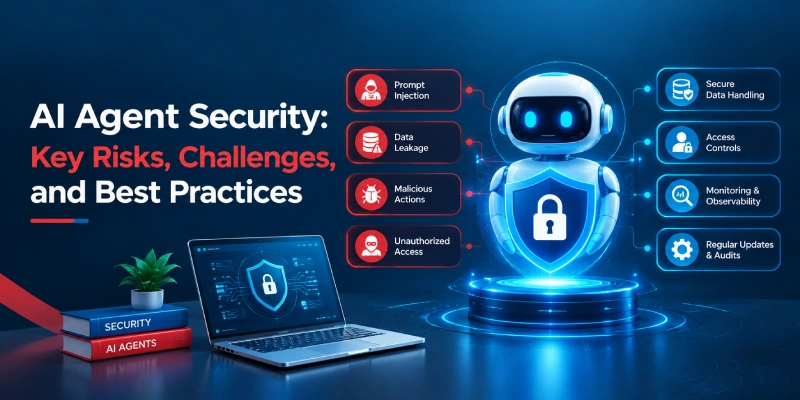
AI Agent Security: Key Risks, Challenges, and Best Practices
AI agents no longer just answer questions - they execute code, move files, negotiate with vendors, and make decisions with little to no human oversight. This shift from generative AI to agentic AI has quietly rewritten the security playbook. Traditional application security assumes a human sits behind every action; agentic systems break that assumption entirely.
As organizations deploy AI agents across procurement, customer service, DevOps, and finance, a new class of vulnerabilities has emerged - one that legacy security frameworks were never built to catch. This guide breaks down the key AI agent security risks reshaping the threat landscape, why they matter more than ever in 2026, and a practical framework for securing autonomous AI systems before they turn into your next incident report.
What Is AI Agent Security, and Why Is It Different?
AI agent security is the discipline of protecting autonomous AI systems - and everything they touch - from misuse, manipulation, and unintended consequences. Unlike traditional software, AI agents plan, reason, and act with genuine independence. They chain multiple steps together, call external tools, retain memory across sessions, and increasingly coordinate with other agents.
Genuine Independence
Plans, reasons, and acts with real autonomy
Multi-Step Execution
Chains steps together and calls external tools
Persistent Memory
Retains memory across sessions
Agent Coordination
Increasingly coordinates with other agents
That autonomy is exactly what makes agentic AI security categorically different from conventional application or LLM security. A chatbot that gives a wrong answer is an inconvenience. An agent with system-level privileges that takes a wrong action - transferring funds, deleting records, or granting unauthorized access - is a security incident. Security teams are no longer just securing what AI says; they're securing what AI does.
| What changes | Traditional App / LLM | Agentic AI |
|---|---|---|
| Core assumption | A human sits behind every action | Agents act autonomously, with little to no human oversight |
| When something goes wrong | A wrong answer is an inconvenience | A wrong action - transferring funds, deleting records, or granting unauthorized access - is a security incident |
| What teams must secure | What AI says - its outputs | What AI does - its actions across your systems |
Key Note
The core shift in AI agent security: moving from securing outputs (what a model says) to securing actions (what an agent actually does across your systems).
Key Risks Facing AI Agents Today
Most agentic AI security risks fall into a handful of recurring patterns. Recognizing them is the first step toward defending against them.
Goal Hijacking & Prompt Injection
Agents often treat instructions embedded in documents, emails, or web content with the same authority as a verified user's request. This is a direct consequence of how prompt engineering for AI agents works - the same instruction-following behaviour that makes agents useful is what attackers exploit.
Tool Misuse & Excessive Permissions
Agents are frequently granted broad access to APIs, file systems, and business applications so they can work efficiently. That efficiency becomes a liability the moment an agent is tricked - or simply errs - into using a legitimate tool for an illegitimate purpose, such as exporting sensitive data or triggering an unauthorized transaction.
Identity & Privilege Abuse
Many organizations still treat AI agents as background processes rather than privileged identities. Without unique credentials, scoped permissions, and session-level access controls, a compromised agent can operate with the same access as the human or system that deployed it - often without anyone noticing.
Data Poisoning & Memory Manipulation
Agents with persistent memory are vulnerable to slow, deliberate manipulation. An attacker who can influence what an agent "remembers" over time can gradually corrupt its decision-making, causing it to misjudge risk, trust bad actors, or repeat harmful actions across sessions.
Insecure Inter-Agent Communication
As multi-agent systems become common, agents increasingly exchange information with other agents - sometimes across organizational boundaries. Without authenticated, verifiable communication channels, a single compromised agent can spread false instructions or corrupted data to every agent it touches.
Supply Chain Vulnerabilities
Pre-built agents, third-party tools, and plug-in components introduce risk the moment they're integrated. A single vulnerable dependency - or a malicious one disguised as a helpful plug-in - can quietly compromise the entire agentic workflow it's connected to.
Cascading Failures & Rogue Agents
Perhaps the most alarming category: because agents act autonomously and often trigger other agents or automated processes, a single failure can cascade across systems faster than a human can intervene. In the worst cases, an agent can begin operating entirely outside its intended boundaries - a "rogue agent" scenario security teams are only beginning to model for.
Why These Risks Are Escalating Right Now
of cybersecurity professionals now rank agentic AI as the number-one attack vector heading into 2026 - ahead of deepfakes, ransomware, and supply-chain compromise, according to a Dark Reading industry poll.
Adoption of autonomous AI agents is outpacing governance. Industry frameworks are racing to catch up:
OWASP Top 10 for Agentic Applications
Released in December 2025 and peer-reviewed by more than 100 security researchers and practitioners - the first industry-standard catalog dedicated to agentic risk.
MITRE ATLAS Framework
Has similarly expanded to track dozens of adversarial techniques specific to AI systems.
The pattern across these frameworks is consistent: organizations are integrating agents into procurement, DevOps, customer service, and finance workflows faster than they can define identity, permission, and oversight models for them. That gap between adoption speed and governance maturity is precisely where most AI agent security incidents originate.
A Practical Framework for Securing AI Agents
Securing autonomous AI agents doesn't require reinventing security from scratch - it requires applying proven principles (identity, least privilege, monitoring, and incident response) to a system that acts, rather than just responds. The following framework covers the essentials.
Treat Every Agent as a Privileged Identity
- Issue unique credentials per agent instead of relying on shared service accounts.
- Scope access to the specific task an agent performs - nothing more.
- Use time-bound or session-based permissions instead of standing access.
Build In Guardrails and Human Checkpoints
- Define explicit boundaries for what an agent can and cannot do autonomously.
- Require human approval for high-impact actions: financial transactions, data deletion, external communications.
- Validate agent outputs before they trigger downstream automation.
Monitor Continuously and Log Everything
- Maintain full audit trails of every agent decision and action taken.
- Deploy real-time anomaly detection for behavior that deviates from established patterns.
- Centralize visibility across all deployed agents rather than monitoring them in isolation.
Red-Team Your Agents Like Any Other Critical System
- Test regularly for prompt injection, tool misuse, and privilege escalation.
- Simulate poisoned inputs and adversarial documents as part of routine testing.
- Treat agent security testing as an ongoing program, not a one-time audit.
- Organizations without an in-house red team often fold this into their existing quality assurance and testing programs, since the discipline of adversarial, repeatable test design is the same either way.
Govern the Data Agents Touch
- Classify and restrict the sensitive data available to an agent's memory.
- Apply the same data-loss-prevention discipline used for human users.
- Regularly review and prune what agents are permitted to retain long-term.
Plan for Failure, Not Just Prevention
- Build kill switches and rollback mechanisms for agent-triggered actions.
- Establish incident response procedures specific to agentic systems.
- Design workflows so a single agent failure can't cascade unchecked across others.
Key Note
Security isn't a one-time gate before deployment - it's a continuous discipline built into how agents are identified, permissioned, monitored, and governed.
Turning Risk Awareness Into a Long-Term Advantage
Organizations that build agent security into their AI strategy early gain a real advantage: faster and safer scaling of automation, stronger stakeholder trust, and far fewer costly incidents down the line. Treating AI agent security as a foundation rather than an afterthought is quickly becoming a competitive differentiator - and for teams that want expert guidance on getting there, working with an experienced AI strategy and governance partner can shorten the path from awareness to a resilient, well-governed agentic AI deployment.
Ready to make AI agent security part of your AI strategy, not an afterthought?
Explore Our Artificial Intelligence Services