

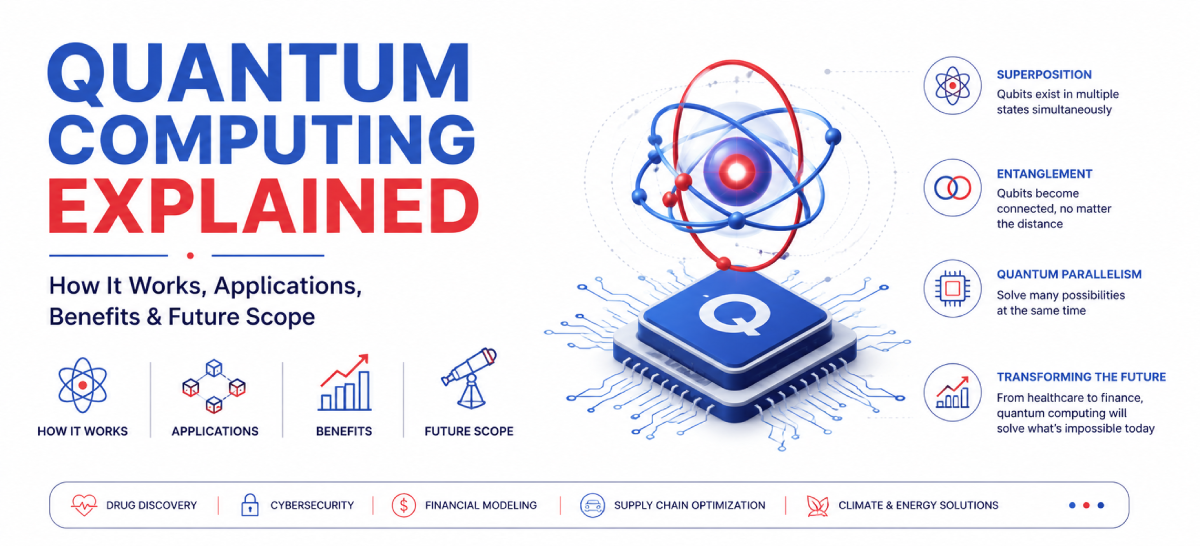
Quantum Computing Explained
How It Works, Applications, Benefits & Future Scope
The world of computing is on the brink of a seismic transformation. As businesses and governments grapple with increasingly complex data problems — from drug discovery to climate modeling — classical computers are hitting fundamental physical limits. Enter quantum computing: a revolutionary paradigm that harnesses the principles of quantum mechanics to process information in ways that conventional machines simply cannot.
For IT professionals navigating today's rapidly evolving technology landscape, understanding quantum computing is no longer optional — it is a career imperative. This comprehensive guide demystifies quantum computing, explains how it works, explores its real-world applications, outlines its tangible benefits, and charts its future trajectory.
Quantum computing is a type of computation that exploits quantum mechanical phenomena — such as superposition, entanglement, and interference — to process data. Unlike classical computers that encode information as binary bits (0 or 1), quantum computers use quantum bits, or qubits, that can exist in multiple states simultaneously.
1. Superposition
A qubit can represent 0 and 1 simultaneously, allowing quantum computers to explore multiple solutions at once — dramatically reducing computation time for complex problems.
2. Entanglement
When qubits become entangled, the state of one qubit instantaneously influences its partner — regardless of physical distance. This enables massively parallel processing and faster data correlation.
3. Interference
Quantum algorithms use interference to amplify paths that lead to correct answers and cancel out paths leading to wrong ones — making computation highly efficient and directional.
At its core, a quantum computer consists of qubits, quantum gates, and measurement systems. The computation begins by initializing qubits, applying quantum gate operations (analogous to logic gates in classical circuits), and finally measuring the output state. Each measurement collapses the qubit into a definitive 0 or 1.
- Qubits: Physical implementations include superconducting circuits (IBM, Google), trapped ions (IonQ, Honeywell), and photonic systems.
- Quantum Gates: These manipulate qubit states — similar to classical AND, OR, NOT gates — but operating on probabilities and phase relationships.
- Quantum Circuits: A sequence of quantum gates applied to qubits to carry out a specific algorithm.
- Error Correction: Due to "quantum decoherence" (environmental noise disrupting qubit states), error correction is a critical and active research area.
- Cryogenic Cooling: Most quantum computers operate near absolute zero (-273°C) to maintain qubit coherence.
| Feature | Classical Computing | Quantum Computing |
|---|---|---|
| Processing Unit | Bits (0 or 1) | Qubits (0, 1, or both) |
| Processing Type | Sequential / linear | Parallel (superposition) |
| Speed | Limited by transistors | Exponentially faster for complex tasks |
| Error Rate | Very low | Currently higher (active research) |
| Best For | General tasks, everyday computing | Optimization, simulation, cryptography |
| Current Cost | Affordable, widely available | High cost, limited availability |
Quantum computing does not replace classical computing — it complements it. Hybrid architectures, combining both paradigms, are expected to dominate enterprise use cases through the 2030s.
Quantum computing is not a future fantasy — it is being tested and deployed in real environments today. Here are the most impactful application domains:
1. Pharmaceuticals & Drug Discovery
Quantum simulations can model molecular interactions at the atomic level — something classical computers cannot do efficiently. Companies like Pfizer and Roche are partnering with quantum firms to accelerate drug discovery pipelines, potentially reducing development timelines from 10–15 years to a fraction of that time.
2. Cybersecurity & Post-Quantum Cryptography
Quantum computers pose both a threat and an opportunity to cybersecurity. Shor's algorithm, running on a sufficiently powerful quantum computer, could break RSA encryption — the backbone of modern internet security. This has prompted NIST to finalize post-quantum cryptographic standards. For IT professionals, understanding quantum-safe encryption is now a critical skill.
3. Financial Services & Portfolio Optimization
Banking giants including Goldman Sachs and JPMorgan Chase are exploring quantum algorithms for risk analysis, portfolio optimization, and fraud detection. Quantum Monte Carlo simulations can process market variables at unprecedented speed.
4. Supply Chain & Logistics Optimization
Quantum optimization algorithms like QAOA (Quantum Approximate Optimization Algorithm) are being tested to solve complex routing and scheduling problems — where even marginal improvements yield millions in savings for global enterprises.
5. Artificial Intelligence & Machine Learning
Quantum machine learning (QML) promises to accelerate training time for neural networks and improve pattern recognition in high-dimensional datasets. Google's quantum AI division and IBM Quantum are already publishing benchmarks showing quantum advantage in select ML tasks.
6. Climate Modeling & Energy
Simulating complex climate systems and discovering new materials for batteries or solar panels requires computing power beyond classical reach. Quantum simulation enables deeper modeling of chemical reactions — directly supporting clean energy innovation.
| Industry | Key Use Cases |
|---|---|
| Healthcare & Life Sciences | Molecular simulation and genomics |
| Financial Services | Risk modeling and algorithmic trading |
| Defense & Intelligence | Secure communications and cryptanalysis |
| Telecommunications | Network optimization and quantum key distribution |
| Manufacturing | Material discovery and process simulation |
| Logistics | Real-time route and supply chain optimization |
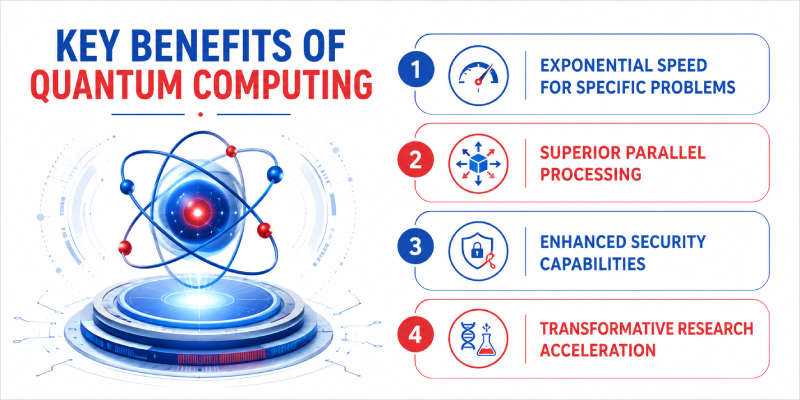
Understanding the benefits of quantum computing helps IT professionals make informed decisions about when and where to advocate for quantum investment within their organizations:
Exponential Speed for Specific Problems
Quantum computers can solve certain optimization and simulation problems exponentially faster than the best classical algorithms — unlocking solutions previously considered computationally infeasible.
Superior Parallel Processing
Superposition allows quantum systems to evaluate multiple possibilities simultaneously, making them ideal for scenarios requiring exhaustive search or simulation across vast solution spaces.
Enhanced Security Capabilities
While quantum computing challenges today's encryption, it also enables quantum key distribution (QKD) — a theoretically unbreakable encryption method based on quantum physics principles.
Transformative Research Acceleration
In materials science, chemistry, and biology, quantum simulations can compress years of laboratory research into days — fundamentally changing the pace of scientific discovery.
The quantum computing industry is in the NISQ era — Noisy Intermediate-Scale Quantum — a phase characterized by quantum processors with 50–1,000+ qubits that are prone to errors but capable of demonstrating quantum advantage for narrow problem classes.
IBM Quantum
Offers cloud-accessible quantum processors via IBM Quantum Experience; roadmap targets 100,000+ qubit systems by 2033.
Google Quantum AI
Claimed quantum supremacy in 2019 with its 53-qubit Sycamore processor; active in quantum error correction research.
Microsoft Azure Quantum
Pursuing topological qubits for greater stability; strong hybrid quantum-classical integration through Azure.
IonQ
Specializes in trapped-ion quantum computers with high gate fidelity; publicly listed and cloud-accessible via AWS and Azure.
D-Wave
Focuses on quantum annealing for optimization problems; widely used in logistics and financial applications.
Major cloud providers — AWS (Amazon Braket), Microsoft Azure Quantum, IBM Quantum Network, and Google Cloud — now offer quantum computing as a service. This means you can experiment with quantum algorithms today without access to specialized hardware.
The future of quantum computing is not a question of 'if' but 'when and how fast.' Here is a forward-looking roadmap every IT professional should internalize:
Hybrid Quantum-Classical Systems
Expect quantum computing to be deployed alongside classical systems to handle specific computational bottlenecks. Quantum-as-a-Service (QaaS) will become mainstream, with enterprise SLAs and API-driven quantum access. Post-quantum cryptography will be widely mandated — especially in regulated sectors like finance and government.
Fault-Tolerant Quantum Computers
Advances in quantum error correction (QEC) will yield the first fault-tolerant quantum computers capable of running complex algorithms without catastrophic error rates. This will unlock transformative applications in AI training, materials discovery, and financial modeling at enterprise scale.
Quantum Supremacy at Scale
Fully programmable, large-scale quantum computers will be commercially available — potentially disrupting entire industries. Quantum internet infrastructure, using quantum key distribution and entanglement-based networking, may redefine global communications security.
- Get familiar with quantum programming languages — Qiskit (IBM), Cirq (Google), Q# (Microsoft)
- Understand post-quantum cryptography standards (NIST PQC) and plan migration strategies
- Explore cloud quantum platforms for hands-on experimentation (IBM Quantum, Amazon Braket)
- Follow NIST, IEEE, and Gartner for quantum readiness frameworks and enterprise guidance
- Identify use cases within your organization where quantum optimization could add measurable value
Quantum computing is a type of computing that uses the principles of quantum physics — like superposition and entanglement — to process data. Unlike classical computers that use bits (0 or 1), quantum computers use qubits that can be 0, 1, or both at the same time, enabling them to solve complex problems much faster for specific tasks.
Yes, sufficiently powerful quantum computers could break widely-used encryption algorithms like RSA and ECC. However, this is still a near-future risk. In response, NIST finalized post-quantum cryptography (PQC) standards in 2024, and IT teams should begin planning cryptographic migrations now to stay ahead of this 'harvest now, decrypt later' threat.
Classical computers process data as binary bits (0 or 1), one state at a time. Quantum computers use qubits that exploit superposition (existing in multiple states), entanglement (instant correlation between qubits), and interference (filtering correct answers) to process vast amounts of data simultaneously, making them exponentially faster for certain problem types.
No — quantum computers are not general-purpose replacements for classical computers. They excel at specific problem types: optimization, simulation, cryptography, and machine learning tasks. For everyday computing — browsing, word processing, running databases — classical computers remain far more practical and cost-effective. Hybrid architectures will dominate for the foreseeable future.
Start with IBM Quantum Experience (free, browser-based), which provides access to real quantum hardware and Qiskit, IBM's open-source quantum SDK. Microsoft's Azure Quantum and Google's Cirq framework also offer excellent learning paths. For formal learning, platforms like Coursera, edX, and MIT OpenCourseWare offer quantum computing courses. NIST's PQC documentation is essential reading for cybersecurity professionals.
Industry analysts and leading quantum firms project that fault-tolerant, commercially viable quantum computing will emerge between 2028 and 2033. However, limited quantum advantage for specific use cases — particularly optimization and simulation — is already accessible via cloud platforms today. Enterprises should begin quantum readiness assessments now to avoid being caught unprepared.
Quantum computing represents one of the most profound technological shifts of the 21st century. For IT professionals, the message is clear: this is not a technology to watch from the sidelines. From post-quantum cryptography migration to hybrid quantum workflows, the ripple effects are already reaching enterprise IT departments.
Understanding the fundamentals — qubits, superposition, entanglement, and quantum gates — is the foundation. Building on that with hands-on experimentation via cloud quantum platforms, and staying current with NIST cryptographic standards, positions IT professionals to be architects of the quantum-ready enterprise rather than reactive respondents to quantum disruption.
Ready to Future-Proof Your IT Career?
Stay ahead of technology — explore expert insights, resources, and practical guides.
Visit Our Website