

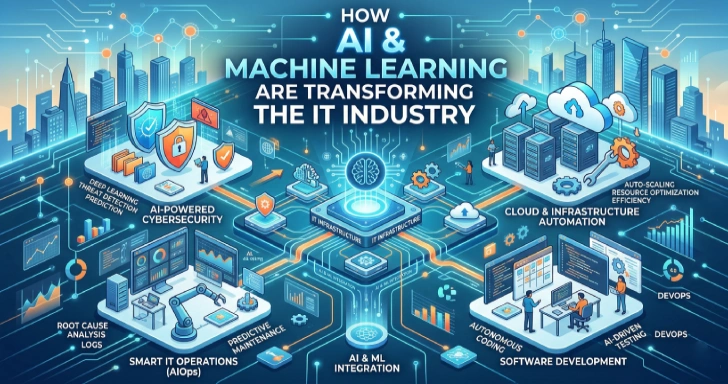
How AI and Machine Learning Are Transforming the IT Industry
Introduction
The IT industry has always been a catalyst for innovation, but the emergence of Artificial Intelligence (AI) and Machine Learning (ML) has accelerated transformation at an unprecedented pace. What was once considered an advanced capability is now becoming a core component of modern IT strategies.
Organizations are rapidly shifting from traditional IT models to intelligent, automated ecosystems powered by AI. This shift is not just about improving efficiency - it is about redefining how businesses operate, scale, and compete in a digital-first world.
From predictive analytics to automated operations, AI and Machine Learning are reshaping every layer of the IT industry.
Understanding AI and Machine Learning in IT
Artificial Intelligence refers to systems that simulate human intelligence, while Machine Learning enables these systems to learn from data and improve performance over time.
In the IT landscape, these technologies are embedded across multiple domains, including:
This integration enables IT systems to move from reactive problem-solving to proactive and predictive decision-making.
Automation of IT Operations (AIOps)
One of the most impactful applications of AI in the IT industry is AIOps - Artificial Intelligence for IT Operations.
Traditional IT operations often involve manual monitoring, troubleshooting, and maintenance. AI transforms this by introducing automation and intelligence into everyday processes.
Key Capabilities:
Business Impact:
AIOps reduces downtime, improves system performance, and significantly lowers operational costs. IT teams can shift their focus from repetitive tasks to strategic initiatives that drive business value.
Enhanced Cybersecurity and Threat Detection
As cyber threats become more complex, traditional security approaches struggle to keep up. AI and Machine Learning bring a proactive and adaptive approach to cybersecurity.
How AI Improves Security:
Machine Learning models evolve by learning from new data, enabling systems to detect even previously unknown threats.
Outcome:
Organizations gain faster threat detection, reduced response times, and stronger protection against cyberattacks.
3. Intelligent Software Development
AI is transforming the software development lifecycle by making it faster, smarter, and more efficient.
AI in Development Includes:
Developers can leverage AI-powered tools to write cleaner code and accelerate project timelines without compromising quality.
Result:
Faster deployment cycles, improved software quality, and reduced development costs.
4. Advanced Data Management and Predictive Analytics
Data is at the core of the IT industry, and AI enhances how organizations collect, process, and analyze it.
AI-Driven Data Capabilities:
Machine Learning algorithms can uncover insights that would otherwise remain hidden in vast datasets.
Business Value:
Organizations can make informed, data-driven decisions that improve efficiency, reduce risks, and drive innovation.
5. Transformation of Cloud Computing
Cloud computing is becoming increasingly intelligent with the integration of AI and Machine Learning.
| AI Enhancement | Description | Benefit |
|---|---|---|
| Automated resource allocation | AI dynamically allocates computing resources based on demand patterns and workload requirements | Optimized resource utilization and cost savings |
| Predictive scaling of workloads | Machine learning predicts traffic spikes and automatically scales infrastructure | Improved performance during peak loads |
| Cost optimization strategies | AI analyzes usage patterns to recommend cost-effective configurations | Reduced cloud infrastructure expenses |
| Intelligent workload distribution | AI optimizes task distribution across cloud resources for maximum efficiency | Faster processing and better performance |
Cloud providers now offer AI-powered services, enabling businesses to integrate advanced capabilities without heavy infrastructure investments.
Outcome:
Improved scalability, better resource utilization, and optimized costs.
6. Personalized User and Customer Experiences
AI is revolutionizing how IT systems interact with users by delivering personalized experiences.
AI-powered chatbots
Virtual assistants that provide instant support and personalized interactions
Personalized recommendations
Tailored suggestions based on user behavior and preferences
Adaptive user interfaces
Interfaces that dynamically adjust to user needs and preferences
Machine Learning analyzes user behavior to tailor experiences based on individual preferences.
Impact:
Enhanced customer satisfaction, increased engagement, and improved retention rates.
7. Evolution of the IT Workforce
AI is not eliminating jobs - it is transforming them.
IT professionals now work alongside AI systems, using them as tools to enhance productivity and innovation.
Insight:
The future workforce will be defined by collaboration between human expertise and intelligent systems.
8. Predictive Maintenance and System Reliability
AI enables organizations to move from reactive maintenance to predictive maintenance.
Continuous Monitoring
24/7 system performance tracking and analysis
Early Failure Detection
Predictive algorithms identify potential issues before they occur
Automated Actions
Proactive maintenance and system optimization
Benefits:
This proactive approach ensures smoother operations and business continuity.
9. Driving Innovation Across Industries
The IT industry serves as the backbone for AI-driven innovation across multiple sectors.
Healthcare
AI-powered diagnostics and patient care
Finance
Fraud detection and risk analysis
Manufacturing
Smart automation and robotics
Retail
Personalized shopping experiences
Challenges of AI in the IT Industry
Despite its advantages, AI adoption comes with challenges that organizations must address:
Data Privacy
Security concerns and compliance requirements
Implementation Costs
High investment and integration expenses
Skills Gap
Shortage of AI and data science professionals
Ethical Concerns
Responsible AI decision-making and bias mitigation
Addressing these challenges is essential for sustainable and responsible AI adoption.
Future of AI and Machine Learning in IT
The future of AI in IT is dynamic and full of possibilities.
Hyperautomation
Across enterprise IT operations and processes
Explainable AI
For transparency and trust in AI decisions
AI with DevOps
Seamless integration in development pipelines
Generative AI
Advanced content creation and automation
AI will continue to evolve, becoming more accessible and deeply integrated into IT ecosystems.
Conclusion
AI and Machine Learning are fundamentally transforming the IT industry. From automating operations and strengthening cybersecurity to enabling predictive analytics and enhancing user experiences, their impact is profound and far-reaching.
Organizations that adopt AI-driven strategies today will be better positioned to innovate, scale, and remain competitive in the future.
The transformation is already underway - the question is how quickly businesses are willing to adapt.