

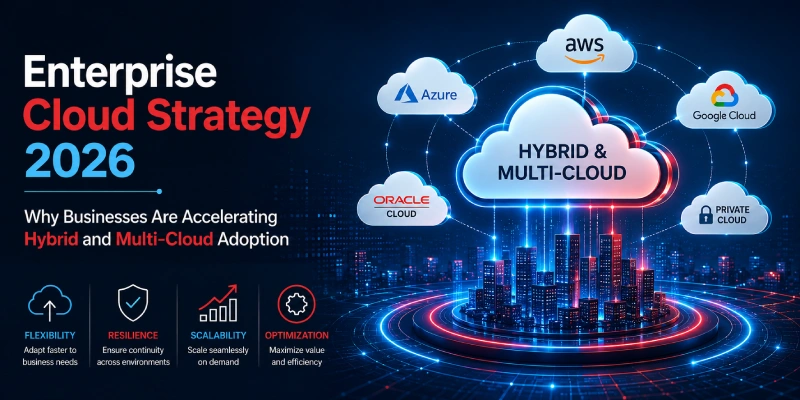
Why Businesses Are Accelerating Hybrid and Multi-Cloud Adoption
Enterprise IT decisions have shifted from whether to adopt cloud infrastructure to determining the optimal combination of environments that deliver flexibility, resilience, and cost control.
Hybrid and multi-cloud adoption has moved from a niche architectural choice to a mainstream operating model, driven by rising infrastructure costs, tightening data regulations, and the computational demands of AI workloads. Boards and technology leaders increasingly treat cloud architecture as a risk-management decision as much as a technical one, weighing provider concentration, data residency, and long-term cost trajectories alongside raw performance. This guide examines the forces behind this shift, the practical benefits organizations are realizing, and a structured framework for building a hybrid multi-cloud strategy that scales.
Cloud architecture is now a risk-management decision — not just a technical one. Provider concentration, data residency, and long-term cost trajectories are board-level considerations.
Understanding Hybrid Cloud vs. Multi-Cloud Strategies
Two distinct approaches that enterprises increasingly combine for maximum flexibility and control.
Hybrid Cloud Architecture
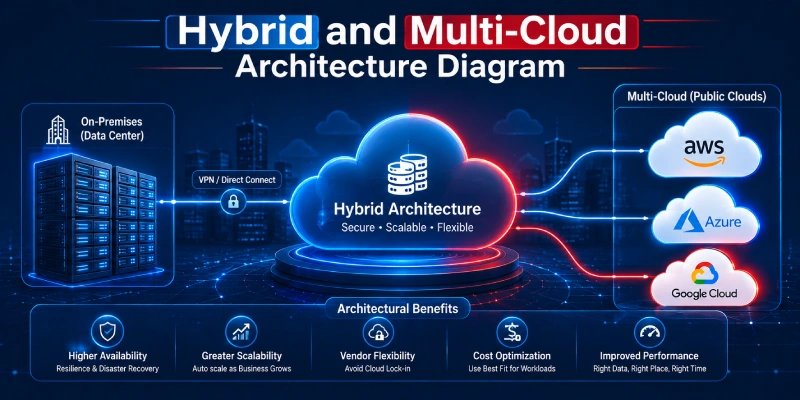
Integrates on-premises private infrastructure with public cloud platforms such as AWS, Microsoft Azure, or Google Cloud, allowing data and applications to move between environments as workload demands change.
Multi-Cloud Architecture
Involves running workloads across multiple public cloud providers simultaneously, often to access best-in-class services or reduce dependency on a single vendor.
Many enterprises now combine both approaches into a hybrid multi-cloud model that balances compliance requirements with the flexibility of distributed cloud services.
| Aspect | Hybrid Cloud | Multi-Cloud Strategy |
|---|---|---|
| Components | Private + public cloud | Multiple public cloud providers |
| Primary Strength | Compliance and data control | Flexibility and best-of-breed services |
| Typical Use Cases | Sensitive workloads, cloud bursting | Avoiding vendor lock-in, innovation |
| Main Complexity | Integration between private and public environments | Managing multiple vendor relationships |
Key Drivers Accelerating Adoption
Several converging factors are pushing organizations toward distributed cloud architectures.
Overcoming Common Challenges
Navigating Complexity in Distributed Environments
Hybrid and multi-cloud environments introduce genuine complexity. A structured framework reduces these risks and keeps implementation manageable, giving technical teams a repeatable process rather than an ad hoc migration.
- Multiple vendor relationships to coordinate and manage
- Inconsistent security policies across environments
- Internal skill gaps requiring training and hiring
- Fragmented visibility across platforms slowing incident response
- Difficult cost attribution when relying on provider-specific dashboards rather than a unified view
A Practical 5-Step Framework for Success
A structured approach that transforms complexity into a repeatable, scalable process.
Step 1: Assessment
Map existing workloads, compliance obligations, and business objectives before selecting an architecture. This foundational step ensures that every subsequent decision is grounded in a clear understanding of current state constraints and future requirements. A thorough assessment reveals which workloads are cloud-ready, which require modification, and which must remain on-premises for regulatory or performance reasons.
Step 2: Strategy Design
Determine the appropriate balance between hybrid and multi-cloud components based on the assessment findings. This involves defining workload placement policies, establishing data sovereignty boundaries, and creating a decision framework that teams can reference when deploying new services. The strategy should align with both immediate migration goals and long-term infrastructure vision.
Step 3: Tool Selection
Standardize on infrastructure tools such as Kubernetes and Terraform, along with unified monitoring platforms, to manage environments consistently. Tool standardization reduces operational overhead, enables automation at scale, and ensures that teams can work across cloud environments without context-switching between entirely different management paradigms.
Step 4: Phased Implementation
Begin with pilot workloads, validate outcomes, and automate migration processes before scaling further. Phased implementation reduces risk by limiting the blast radius of any single migration, creates opportunities to refine processes based on real-world feedback, and builds organizational confidence through demonstrated success.
Step 5: Continuous Optimization
Apply FinOps practices and conduct regular governance reviews to control costs and maintain compliance over time. Cloud environments are not static — workloads evolve, pricing models change, and new services become available. Continuous optimization ensures that the architecture remains aligned with business objectives and cost targets.
Real-World Benefits of Hybrid Multi-Cloud Strategies
Organizations that adopt hybrid multi-cloud strategies report measurable advantages over single-cloud deployments.
2.5x Greater Value
Up to 2.5 times greater overall value compared to single-cloud deployments
Faster Innovation
Faster innovation cycles through flexible workload placement
Improved Security
Improved security posture alongside better cost efficiency
Faster Releases
Features released faster — tested and deployed on the best-suited platform
These gains compound over time as governance practices mature and teams become more proficient at managing distributed environments. Procurement teams also gain leverage during renewal cycles, as workloads are not tied to a single provider's pricing structure.
Future Trends in 2026 and Beyond
Cloud strategy continues to evolve alongside advances in AI and infrastructure tooling. Four trends are shaping the next phase.
-
AI-Orchestrated Workload Management — Intelligent systems automatically place workloads based on cost, performance, and compliance criteria, removing manual decision-making bottlenecks and optimizing in real time.
-
Deeper Edge Computing Integration — Extending hybrid architectures closer to where data is generated, enabling low-latency processing for IoT, manufacturing, and real-time analytics use cases.
-
Sustainability-Focused Cloud Provider Selection — Organizations factor carbon impact into infrastructure decisions, choosing providers based on renewable energy commitments and efficiency metrics.
-
Advanced Observability Platforms — Unified visibility across increasingly distributed environments, providing real-time insights into performance, cost, and security across all cloud and on-premises resources.
Frequently Asked Questions
Clear answers to the most common questions about hybrid and multi-cloud adoption.
-
What is the difference between hybrid cloud and multi-cloud?Hybrid cloud combines private, on-premises infrastructure with public cloud services. Multi-cloud uses multiple public cloud providers, without necessarily including private infrastructure.
-
Is hybrid or multi-cloud adoption suitable for small businesses?Yes. Smaller organizations can start with two cloud providers and a limited set of workloads, then scale the architecture as requirements grow.
-
How should an organization begin hybrid cloud adoption?A structured assessment of existing workloads and compliance needs, followed by a pilot project on non-critical systems, provides a practical starting point.
-
Which industries benefit most from hybrid and multi-cloud strategies?Finance, healthcare, government, and retail see the strongest benefits, largely due to strict compliance requirements and highly variable workload demands.
-
Does multi-cloud adoption increase security risk?Multi-cloud environments require consistent security policies across providers. When managed with unified monitoring and governance, the approach can improve overall resilience rather than weaken it.
Ready to Build a Resilient Cloud Strategy?
Hybrid and multi-cloud adoption has become a strategic requirement rather than an optional upgrade for organizations pursuing agility, regulatory compliance, and competitive advantage. A phased, well-governed approach, grounded in clear assessment and continuous optimization, allows businesses to capture these benefits while managing the added complexity of distributed infrastructure.
A well-governed hybrid multi-cloud approach strengthens resilience, controls costs, and positions infrastructure for AI-driven growth.
Get Started with Premier IT Solutionswww.premieritsolutions.com